



Unlocking Hidden Property Value: The Role of Strategic Redevelopment and Asset Optimisation
Follow Us On:


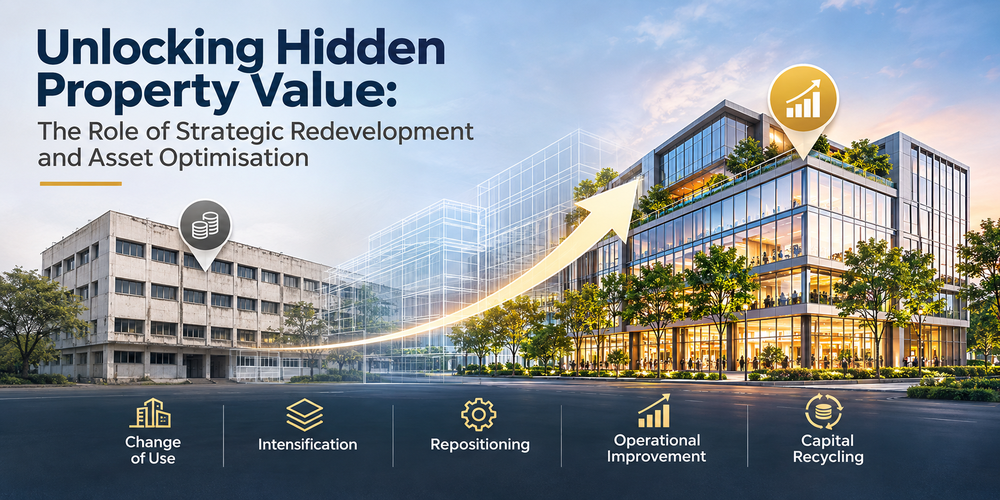
Unlocking Hidden Property Value: The Role of Strategic Redevelopment and Asset Optimisation
Some of the most valuable assets in a portfolio are the ones that look ordinary. An ageing office block, a low-rise industrial unit, a plot of surplus land beside a growing institution. They earn something today, so they rarely get a second look. Yet in global real estate, the gap between what a property earns and what it could earn is often where the largest opportunity sits. Strategic redevelopment and asset optimisation are how owners close that gap.
What is strategic redevelopment and asset optimisation?
It means turning underperforming, obsolete or underused property into productive value through better use, repositioning, conversion, densification or disposal. The central question moves beyond current income to this: what is the asset’s highest and best feasible use, and which intervention captures that value?
Why value stays hidden
Property value is often held back by legacy design, outdated use, weak tenancy, poor energy performance, fragmented ownership or land that isn’t used intensively enough. Obsolescence isn’t only physical. It can be functional, economic, regulatory or environmental. A structured portfolio review can surface options that weren’t obvious at first, particularly for vacant land and low-utilisation sites. Energy upgrades aligned with a building’s existing structure can also future-proof an asset and create upside. Deep conversions, however, carry greater cost, execution and market risk.
A five-stage framework
| Stage | Key question | Typical output |
|---|---|---|
| Asset review | Why do we own it, how is it performing, what risks does it carry? | Portfolio classification and performance baseline |
| Market and planning scan | What uses, densities, tenants and infrastructure changes are feasible? | Location intelligence and opportunity shortlist |
| Highest-and-best-use analysis | Which use creates the strongest risk-adjusted value? | Ranked options: redevelop, repurpose, refurbish or sell |
| Feasibility and modelling | Do returns justify the capital, time, approvals and risk? | Financial model, budget and sensitivity analysis |
| Execution | Who funds, designs, develops, leases and manages? | Delivery structure, capital partner and management plan |
Five levers for value creation
• Change of use: Convert obsolete offices, industrial units or retail space into residential, life sciences, logistics, data centres, student housing or mixed-use formats, where demand and planning policy support it.
• Intensification: Add floors, reconfigure plots, consolidate parcels or develop surplus land, provided zoning, infrastructure and construction economics work.
• Repositioning: Upgrade specifications, amenities, sustainability performance and tenant mix to move into a stronger market segment.
• Operational improvement: Renegotiate leases, reduce vacancy and align operating costs with income potential. Good real estate asset management and property management often unlock value without a single brick being laid.
• Capital recycling: Sell non-core or poorly positioned assets and redeploy the proceeds into higher-return opportunities. Sometimes disposal is the most effective route to releasing value.
A practical example
Consider a family office holding surplus land next to an educational institution. A review might test a mixed-use scheme combining student housing and retail. It could reveal a revenue stream the current low-intensity use never produces, while also meeting genuine local housing demand. The decisive test, though, is not whether property redevelopment is possible. It is whether the incremental value exceeds the full cost of acquisition, approvals, design, construction, financing, vacancy and risk.
Build the numbers from the bottom up
Don’t rely on a headline yield. A proper pro forma covers acquisition and diligence costs, construction and soft costs, contingency, financing, expected rent or sale price, lease-up period, operating expenses and exit assumptions. The outputs that matter are project IRR, equity multiple, NPV at your required return, development margin or yield-on-cost, and debt service coverage ratio. Lender minimums for the latter are commonly around 1.20x or higher. A deal should clear your hurdle rate after contingency and delay, not only in the base case.
Know the risks
Redevelopment creates value through optionality, but it is exposed to planning delays, construction inflation, funding constraints, shifting tenant demand and changing regulation. Deep retrofits and conversions can deliver substantial uplift, yet their higher risk means they need rigorous feasibility work and market validation before capital is committed. The aim isn’t simply to build more. It is to choose the intervention that improves performance, resilience and long-term value.
Treat it as a discipline, not a one-off
For owners and investors, asset optimisation works best as a recurring capital-allocation habit rather than a single project. Data-led screening, spatial analysis and scenario testing can narrow a broad portfolio into a focused set of acquisition, disposal and redevelopment opportunities, surfacing value earlier and reducing noise. This applies equally to real estate investment decisions and to real estate development plans.
One question is worth asking of every property you hold: “If we were not already the owner, would we buy this asset at today’s value? And if not, what change would make it worth owning?”